When a recurring invoice template is the right choice
Use one when the work repeats and the bill looks almost identical each time: a maintenance plan, a standing weekly visit, software seats or a regular supply order. If the scope or price swings a lot between cycles, build each bill from scratch with an itemized invoice layout instead.
- Monthly invoice template: maintenance plans, equipment rental, managed services, bookkeeping packages.
- Weekly invoice template: mowing rounds, office cleaning, regular deliveries, weekly lessons.
- Subscription invoice template: software seats, memberships or data feeds billed per user.
Which fields stay fixed and which change each cycle
The value of a repeat layout is that most of it never moves. Your details, the customer’s details, the payment terms and the main plan line stay put. A handful of fields must change every single time, and forgetting one of them is how duplicate or confusing bills reach a customer.
| Field | Same each cycle? | What to do |
|---|---|---|
| Customer name, address and PO number | Usually | Update when their PO renews |
| Invoice number | No | Take the next number in your sequence |
| Issue date and due date | No | New dates, same gap between them |
| Service period | No | Write the exact first and last day |
| Main plan line and price | Usually | Change only after written notice |
| One-off extras | No | Delete last cycle’s extras, add this cycle’s |
Wording the lines for weekly, monthly and subscription billing
The service line should tell the customer exactly which slice of time they are paying for. A line that only says “Monthly service” gives their accounts team nothing to match against. Put the period, the unit and the count in the description, so the bill can be checked without opening the contract.
- Weekly: “Lawn mowing and edging, weeks of 5, 12, 19 and 26 October (4 visits)” at 4 x $55.
- Monthly: “Bookkeeping package, October 2026, up to 80 transactions” at $350.
- Subscription: “Scheduling software, 12 user seats, 1 to 31 October 2026” at 12 x $9.
- Usage on top: “Transactions over plan, 23 at $1.50” as its own line, below the plan line.
Prices are examples only.
Worked example: a monthly plant care bill with GST
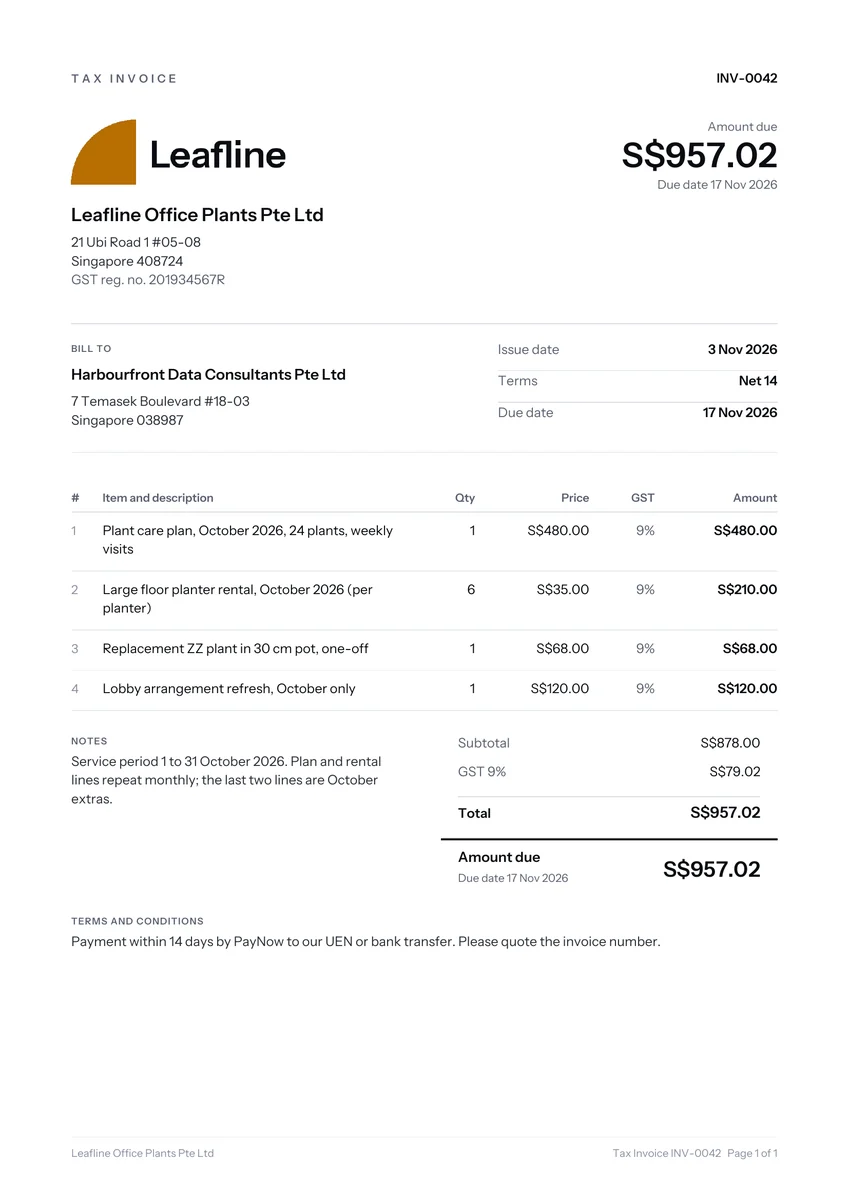
Here a made up Singapore company bills an office for October. It is GST registered, so the document is titled Tax Invoice and adds GST at 9%, the current rate published by IRAS. The first two lines repeat every month; the replacement plant and the lobby refresh are October extras only.
| Line | Qty | Unit price (S$) | Amount (S$) |
|---|---|---|---|
| Plant care plan, October 2026, 24 plants, weekly visits | 1 | 480.00 | 480.00 |
| Large floor planter rental, per planter | 6 | 35.00 | 210.00 |
| Replacement ZZ plant, 30 cm pot | 1 | 68.00 | 68.00 |
| Lobby arrangement refresh | 1 | 120.00 | 120.00 |
Total before GST is S$878.00, GST at 9% is S$79.02, and the total is S$957.02. In November the plan and rental lines carry over and the extras come off. IRAS also allows a simplified tax invoice when the total including GST is S$1,000 or less.
Recurring invoice, retainer invoice or statement?
These three get mixed up because they all arrive on a schedule. A recurring invoice bills a defined service provided in a set period. A retainer invoice bills for reserved time or availability, usually in advance. A statement is not a bill at all: it lists invoices already sent and shows which are still open.
- Use a retainer invoice when the customer pays to hold a block of your hours, used or not.
- Send a statement when a customer wants one summary of several open bills.
- For one large job paid in stages, a progress billing invoice fits better.
Mistakes when copying last month's invoice
Duplicating the previous bill is quick, and also the easiest way to send something wrong. Nearly every repeat billing error comes from a field that was copied across but never updated. A short check before you download catches almost all of them.
- The same number twice. The customer’s system may reject or ignore the second one.
- Last month’s period left in the line. “September” on a bill dated 1 November looks like a duplicate.
- Extras carried forward. October’s replacement plant should not reappear in November.
- A price rise with no warning. Give written notice first.
- Billing a paused month. If service stopped, skip that bill, or issue a credit note for anything already charged.
Filling in and sending this template each cycle
Download the Word, Excel or PDF version from this page, or open the recurring billing sample in the generator, which loads the plant care lines above. Swap in your plan and period, then download a PDF. Your last 20 invoices stay in this browser, ready to reopen next cycle.
This generator does not send bills on a timer. With many customers on cycles, WhizInvoice can send them on a schedule. For number sequences and mid month starts, read how recurring billing works. If a repeat bill goes unpaid, move to the past due invoice template, and browse every layout on the invoice templates page.
Fill it in on screen and download or email a real PDF. No sign up.