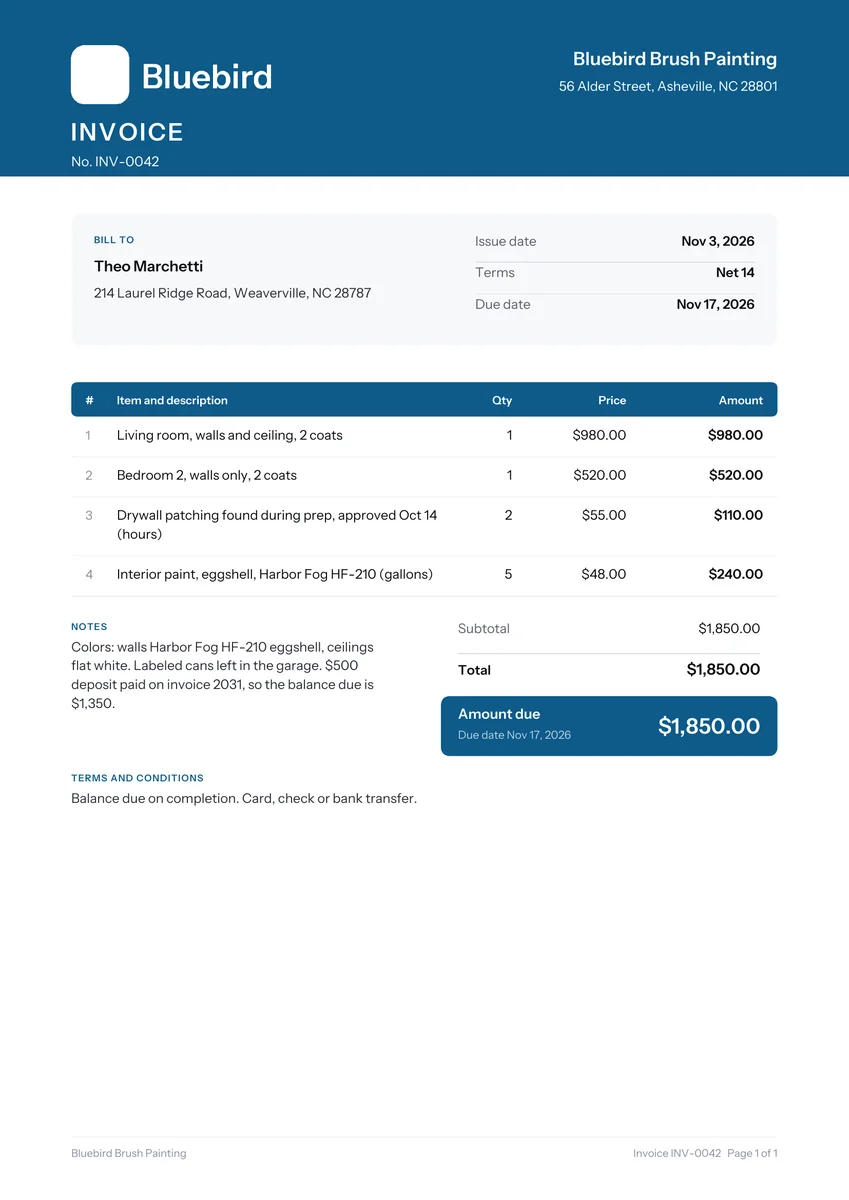
How painters usually price and bill
Painters typically price per room for interiors, per square foot of wall or siding area for larger jobs, or as one price for the whole job. Prep and repairs are often billed by the hour when their size is unknown. Paint is either included in the price or listed separately by the gallon.
When you bill per square foot, say which area you measured. Wall area and floor area give very different numbers, and a customer comparing your invoice with your quote needs to know which one you used.
Example lines on a painting invoice template
Painting invoices read best when every room or surface is its own line, with what was painted and how many coats. “Paint living room” is vague; “Living room, walls and ceiling, 2 coats” is not. The prices shown are examples, there to illustrate the unit each surface is usually priced in.
| Line item | How it is usually charged | Example price |
|---|---|---|
| Living room, walls and ceiling, 2 coats | Per room | $980 |
| Bedroom, walls only, 2 coats | Per room | $520 |
| Exterior siding | Per square foot of wall area | $2.40 per sq ft |
| Interior doors and frames | Per door | $75 each |
| Drywall patching and sanding | Hourly | $55 per hour |
| Interior paint, eggshell | Per gallon | $48 per gallon |
Record the paint colors on the invoice
Writing the paint details on the invoice is one of the most useful things a painter can do for a customer. Note the brand, the color name and code, the sheen and the room. When a wall gets scuffed two years later, the customer, or you, can match it exactly without guessing.
A notes line might read: “Walls, living room and hall: Harbor Fog HF-210, eggshell. Ceilings: flat white. Trim: semi gloss white.” Many painters also leave a labeled can of each color with the customer and mention it here.
Billing extra work found during prep
Prep often turns up problems nobody could see at the quote stage, such as soft window trim, cracked plaster or water stains that need sealing. Stop, show the customer, agree a price or an hourly allowance, and then bill it as a separate line marked as additional work with the approval date.
Keeping the extra apart from the quoted rooms means the customer can see the original price was honored. Reference any photos you sent, such as “Rot in sill, photos sent Oct 13”. For exterior jobs, note any weather days, but only bill them if your agreement says so.
Painting invoice mistakes
Painting invoices tend to cause questions when they are less specific than the quote was. The customer remembers what was promised, so every line should be easy to match against it. Check these points before you send the invoice for any job.
- “Walls” when you also did ceilings and trim. Name every surface you painted.
- Not stating the number of coats. One coat and two coats are very different jobs.
- Forgetting to deduct the deposit. Show it with its invoice number and the balance due.
- Surprise repair charges. Extra prep needs approval before it appears on the invoice.
- No color record. Leaving out the paint details costs the customer later and you a callback.
How to use the painting template
Download the painting layout as a Word document, an Excel spreadsheet or a PDF using the buttons on this page. Or start in the painting invoice generator with a sample job, which loads two rooms, a drywall repair and the paint, so you only change the details.
Put your colors in the notes field and download a PDF. Our guide to deposit invoices shows how to bill paint money up front. For odd jobs alongside painting, try the handyman invoice; for whole renovations, the construction invoice with progress billing. More designs are in the invoice template library, and WhizQuote’s painting quote template covers the quote.
Fill it in on screen and download or email a real PDF. No sign up.