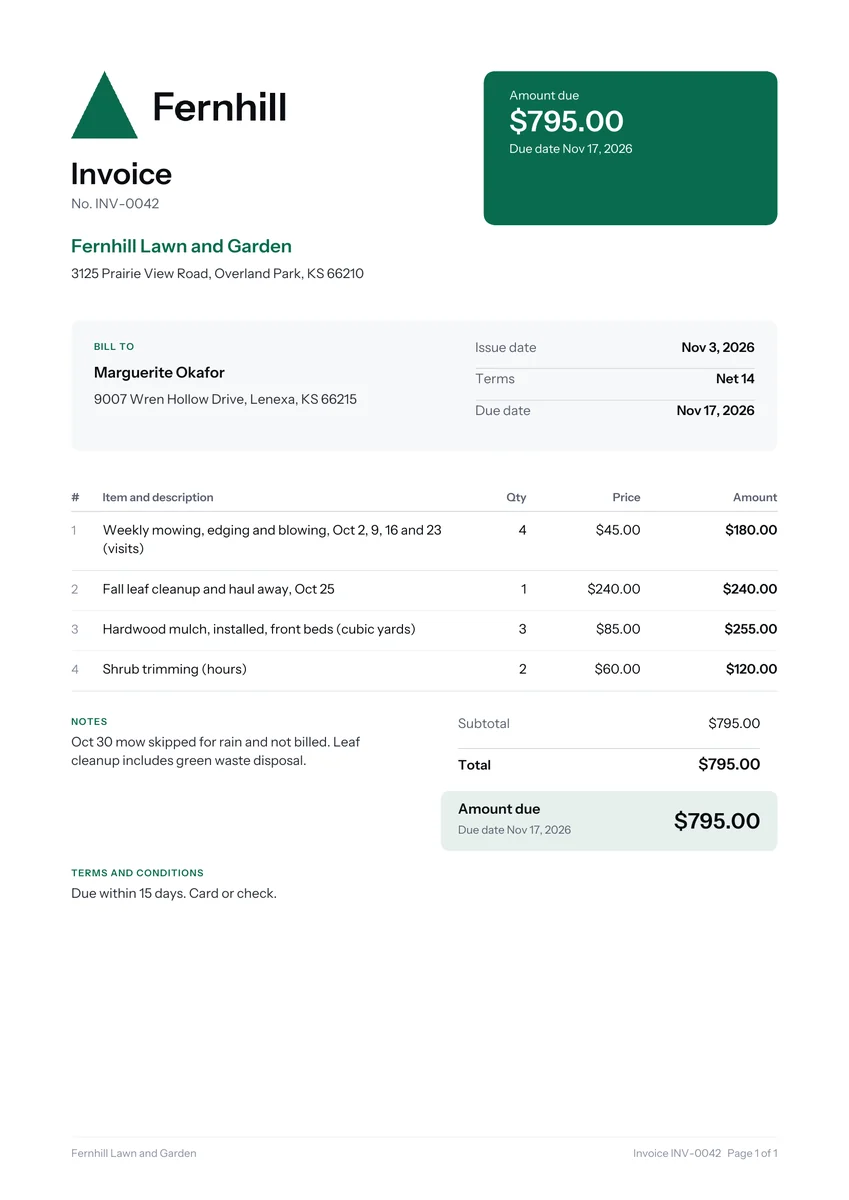
Maintenance work and install work bill differently
Landscapers usually run two kinds of work, and they invoice differently. Maintenance, such as mowing and trimming, repeats on a schedule and is billed per visit or as a monthly fee. Installs, such as new beds, sod or a paver patio, are one off projects billed on a quote, often with a deposit and a final invoice.
Keep the two on separate invoices where you can. A customer who pays for mowing by card each month may want to approve a $4,000 patio separately, and mixing them makes both harder to track.
Example lines on a landscaping invoice template
Landscaping lines are clearest when each one has a unit: a visit, an hour, a cubic yard, a square foot or a plant. Treat each price as an example of the charging unit, not a going rate, since yard sizes and material costs vary a lot.
| Line item | How it is usually charged | Example price |
|---|---|---|
| Mowing, edging and blowing | Per visit | $45 per visit |
| Fall leaf cleanup | Flat per job | $240 |
| Hardwood mulch, installed | Per cubic yard | $85 per yard |
| Sod, supplied and laid | Per square foot | $1.60 per sq ft |
| Shrubs, 3 gallon | Per plant, installed | $48 each |
| Hedge and shrub trimming | Hourly | $60 per hour |
| Green waste disposal | Per load | $65 per load |
Billing a lawn care season
For lawn care you can bill each visit, or spread a season’s work into equal monthly payments. Per visit billing is simple and matches the work exactly. A flat monthly fee smooths cash flow for both sides, but you need to agree in advance what happens when rain or drought means fewer cuts.
An example: 35 weekly visits at $45 comes to $1,575, which is $225 a month over a seven month season. On a per visit invoice, list each date; on a monthly one, name the month and the plan. Our article on setting an invoice due date helps you pick a regular billing day.
Installs: quantities, deposits and plant warranties
Install invoices should show quantities the customer can picture: 3 cubic yards of mulch, 600 square feet of sod, 12 shrubs in 3 gallon pots. Many landscapers take a deposit to cover materials before the job starts, then bill the balance on completion with the deposit shown as paid.
If you offer a plant warranty, put its conditions on the invoice, such as “Replacement within 90 days if watered as instructed”. In metric countries, use cubic meters and square meters instead. GST and VAT registered landscapers can see our New Zealand invoice template or read about deposit invoices.
Landscaping invoice mistakes
Landscaping invoices go wrong in two places: recurring visits with fuzzy dates, and installs with fuzzy quantities. Both leave the customer guessing what they paid for, which delays payment and can sour a long term account. These are the ones to check before sending.
- Billing “October mowing” with no dates. List each visit date so a skipped week is obvious.
- Charging for a rained out visit. Unless your plan says otherwise, leave it off and note it.
- Materials without units. “Mulch, $255” is unclear; “3 cubic yards at $85” is not.
- Hidden disposal costs. If haul away was extra, it needs its own line.
- Billing the resident for HOA work. Confirm who pays for common areas.
Using the landscaping template and generator
The landscaping layout downloads from this page as a Word document, an Excel sheet or a PDF. Prefer working online? The lawn care invoice generator with sample visits opens with a month of mowing, a leaf cleanup and a mulch job, ready to change.
Edit the dates and quantities, add your logo and download a PDF. House cleaners on similar visit schedules use our cleaning invoice, and small outdoor repairs fit the handyman invoice template. Every design is on the invoice templates page, and the landscaping quote template on WhizQuote helps you price installs first.
Fill it in on screen and download or email a real PDF. No sign up.