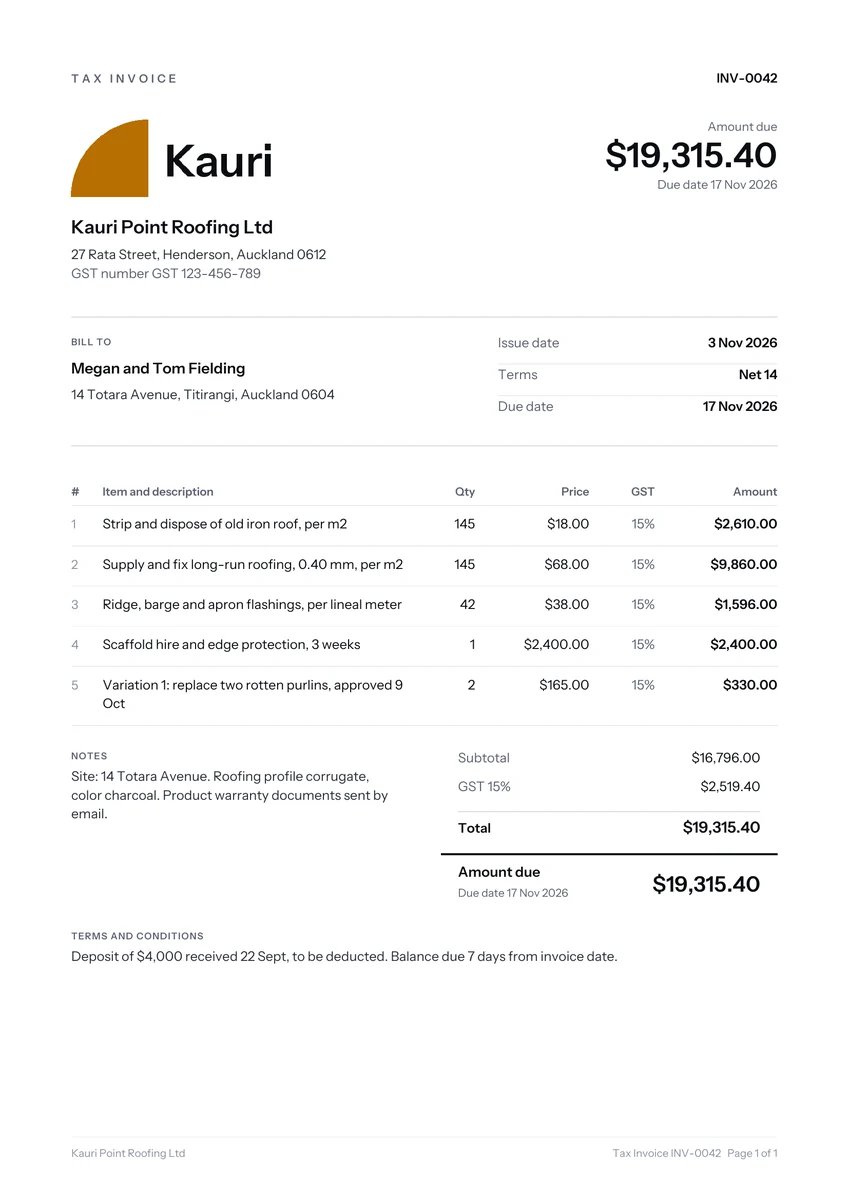
How roofers price work: area, length and access
Roofers price most work by measurement. Cladding, stripping and underlay go by square meter of roof area, measured along the pitch, not the floor plan. Ridges, barges, aprons and spouting go by lineal meter. Scaffold and edge protection are priced per job or per week because they depend on access, not size.
Put the measured quantity in the quantity column and the rate per unit beside it. A customer who sees “145 m2 at $68” can check it against the quote. A single line reading “Re-roof, $17,600” cannot be checked, and that is where arguments start.
Example lines on a roofer invoice
A re-roof invoice usually has five to eight lines: removal, new cladding, underlay, flashings, spouting if replaced, scaffold and any variations. The prices below are examples in New Zealand dollars, excluding GST, to show how each line is counted, not what to charge.
| Line | Unit | Example rate (NZD) |
|---|---|---|
| Strip and dispose of old iron | Per m2 | $18 |
| Supply and fix long-run roofing | Per m2 | $68 |
| Ridge, barge and apron flashings | Per lineal meter | $38 |
| Replace spouting and downpipes | Per lineal meter | $55 |
| Scaffold hire and edge protection | Per job | $2,400 |
| Replace rotten purlin, found on strip | Per item, as approved | $165 |
Variations and progress claims on a roof repair invoice
Old roofs hide problems. Rotten timber, rusted fixings or a damaged valley often only show once the cladding is off. Photograph the problem, get the owner’s approval in writing with a price, then bill it as its own line marked “variation” with the approval date, so it is clearly separate from the quoted work.
On larger jobs, roofers often bill in stages: a deposit for materials, a progress claim when the old roof is off and the new one is going on, and a final invoice on completion. Each invoice should show the contract total, what has been billed so far and what is left. The progress billing invoice is set up for that layout.
What a roofing invoice template needs for GST in New Zealand
Inland Revenue charges GST at 15%. Since 1 April 2023 the rules talk about “taxable supply information” rather than tax invoices, though you can keep using a single document titled “Tax Invoice”. What it must show depends on the value, and most roofing jobs sit in the top band.
- Over $200: your name or trade name and GST number, the date, a description, and either the GST exclusive amount, GST and GST inclusive total, or the inclusive total with a statement that GST is included.
- Over $1,000: all of that, plus the buyer’s name and one identifier, such as an address, phone number or email, when the buyer is GST registered.
- Your GST number is the same as your IRD number.
- For supplies over $200, a GST registered buyer can ask for this information, and you must give it within 28 days.
Our New Zealand invoice template covers registration and the lower bands.
Roofing invoice mistakes to avoid
Roofing invoices are large, so customers read them closely and banks or builders may check them line by line. The mistakes below cause most of the delay, and each is easy to fix before the invoice goes out.
- Billing plan area instead of roof area. If you priced by pitched area, say so in the line.
- Charging a variation without a written approval. Note the date the owner agreed.
- Leaving out the product and color. Name the profile, gauge and color so warranty claims are simple.
- Forgetting deposits already paid. Subtract them on the final invoice with dates.
- No site address. The billing address is often not the roof you worked on.
Using the roofing template and generator
Download this roofing layout as a Word file, Excel sheet or PDF from the buttons above. Or open the roofing invoice generator with a re-roof loaded, which adds 15% GST for New Zealand, and edit the areas, rates and customer details.
Price the next job first with the roofing quote template on WhizQuote. Builders managing a whole renovation can use the construction invoice, panel installers have a solar installation invoice, and the rest are on the templates hub. For slow payers, see how to get paid faster.
Fill it in on screen and download or email a real PDF. No sign up.