When a progress billing invoice template makes sense
Use stage billing on any job long enough or large enough that waiting until the end would strain your cash. Office fit-outs, custom joinery, software builds, conference production and large landscape installs all suit it. The contract should list the stages and their values before work starts, so each invoice simply follows that plan.
If the job is short or the price is small, one invoice on completion is simpler. If you need money before any work starts, that is a deposit, billed separately.
Milestone billing or percent complete
There are two common ways to work out each stage amount. Milestone billing charges a fixed share when a defined result is signed off. Percent complete billing charges for the share of each work item finished since the last claim. Milestones are easier to check; percent complete follows the work more closely on big projects.
| Milestone billing | Percent complete | |
|---|---|---|
| Trigger | A named result is approved | A set date, often monthly |
| Amount | Fixed share agreed upfront | Value times progress since last claim |
| Typical jobs | Fit-outs, software, design projects | Large builds and civil works |
| What the customer checks | Sign off or handover note | Site measurement or progress report |
Builders who bill monthly against a schedule of values with retention held back will find that layout on our construction invoice template.
What every stage invoice must show
Each stage invoice must stand on its own and still connect to the whole job. The customer, and anyone auditing later, should see at a glance which stage this is, what it costs, and how much of the contract has been billed so far. Put these details on every one, in the same order.
- Contract or purchase order reference and the total contract value.
- Stage number out of the total, such as “Stage 3 of 4”, with what was completed.
- The amount for this stage, and approved variations as separate numbered lines.
- Billed before this invoice, billed to date and balance of contract.
- Any deposit being deducted, with the invoice it was paid on.
- The date the stage was completed or certified, if different from the issue date.
Worked example: a Dubai office fit-out in four stages
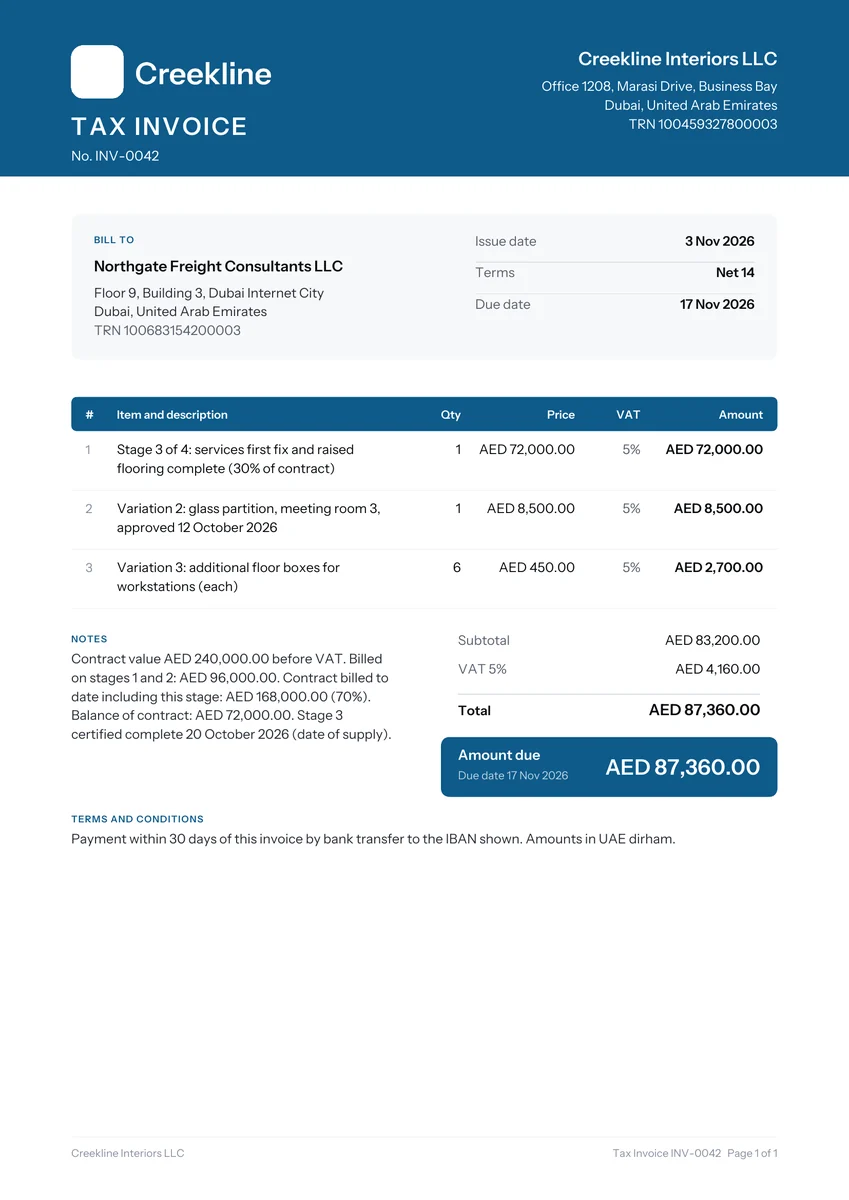
A made up Dubai interiors company has a contract worth AED 240,000 before VAT, split into four milestones of 10%, 30%, 30% and 30%. Stages 1 and 2 were billed at AED 96,000. Stage 3 was certified on 20 October 2026, along with two approved variations.
| Line | Amount (AED) |
|---|---|
| Stage 3 of 4: services first fix and raised flooring (30%) | 72,000.00 |
| Variation 2: glass partition, meeting room 3 | 8,500.00 |
| Variation 3: floor boxes, 6 at AED 450 | 2,700.00 |
| Total before VAT | 83,200.00 |
| VAT at 5% | 4,160.00 |
| Total payable | 87,360.00 |
Contract billed to date is AED 168,000 (70%), leaving AED 72,000 for handover. The FTA sets UAE VAT at 5% and requires a tax invoice within 14 calendar days of each taxable supply, with the date of supply shown when it differs from the issue date, and VAT stated in dirham.
Progress invoice, deposit invoice or final invoice?
All three can appear on the same job, at different points. A deposit is paid before work begins. Progress invoices follow the work as each stage is done. The final invoice closes the contract, bills the last stage and reconciles everything paid. Keeping them distinct makes the running totals easy to follow.
- Taking money upfront? Our guide to deposit invoices covers how to deduct it later.
- Billing the last stage and closing the account? Use the final invoice template.
- Charging a fixed monthly fee for ongoing advice instead of stages? A retainer invoice fits that.
Stage billing mistakes that delay payment
Stage invoices are checked against the contract and the site, so any mismatch gets noticed. One disputed line can hold up the whole payment. These errors come up again and again, and each is avoidable with a quick look at the contract before you bill.
- Billing a milestone before sign off. Wait for the handover note or approval email.
- Folding variations into the stage line. Number them and bill them separately.
- Percentages that do not add up. Stages must total 100% of the contract.
- No running total. Without billed to date, the customer has to rebuild your history.
- Forgetting the deposit. Deduct it exactly as the contract says.
Setting up stage invoices in the generator
Open the stage payment sample in the invoice generator to start from the fit-out example, then type your own stage, variations and contract figures. The running totals go in the notes. Each stage gets the next number in your sequence, and a Word, Excel or PDF copy is on this page if you prefer a file.
Choose the UAE country preset to add VAT at 5%, or see our UAE invoice template for the full tax invoice rules. Other layouts, from hourly to itemized, are on the invoice templates page.
Fill it in on screen and download or email a real PDF. No sign up.