Who uses a retainer invoice template
Retainers suit work that is ongoing but uneven: the client knows they will need you every month, just not exactly when. Public relations and marketing agencies, IT support providers, bookkeepers, designers and business consultants often work this way. The fixed fee gives you steady income and gives the client priority access.
If the service is the same every month and does not depend on hours, a plain repeat bill is simpler. If the client only pays for hours actually worked, bill those as you go instead.
Two kinds of retainer and how each is billed
Most retainers are one of two types, and the invoice looks different for each. An availability retainer charges the same fee every period for a block of hours. A prepaid retainer is a sum paid upfront that you draw down as you work, showing the remaining balance each time you bill.
| Availability retainer | Prepaid drawdown | |
|---|---|---|
| Client pays for | Reserved hours each month | Future work, paid in advance |
| Invoice timing | Start of each period | Once to fund, then to top up |
| Unused hours | Lapse or roll over, per agreement | Stay as credit until used or refunded |
| What each bill shows | Fee, hours included, overage | Work done, amount drawn, balance left |
Law firms and others holding client money in trust have separate rules set by their regulator, so check those before using a general template.
What a monthly retainer invoice should show
The fee alone is not enough. A good retainer bill answers the question every client eventually asks: what did we get for it? Show the period, what the fee includes and a short usage summary for the period just ended, so the value is visible without a separate report.
- The retainer period, such as “1 to 30 November 2026”.
- What the fee includes: hours, response times or named services.
- Hours used last period, and any rolled over or lapsed.
- Overage hours from last period at the agreed rate, on their own line.
- Any pass-through costs, such as subscriptions you pay on the client’s behalf.
- A reference to the signed retainer agreement and its notice period.
Worked example: an Australian PR retainer with GST
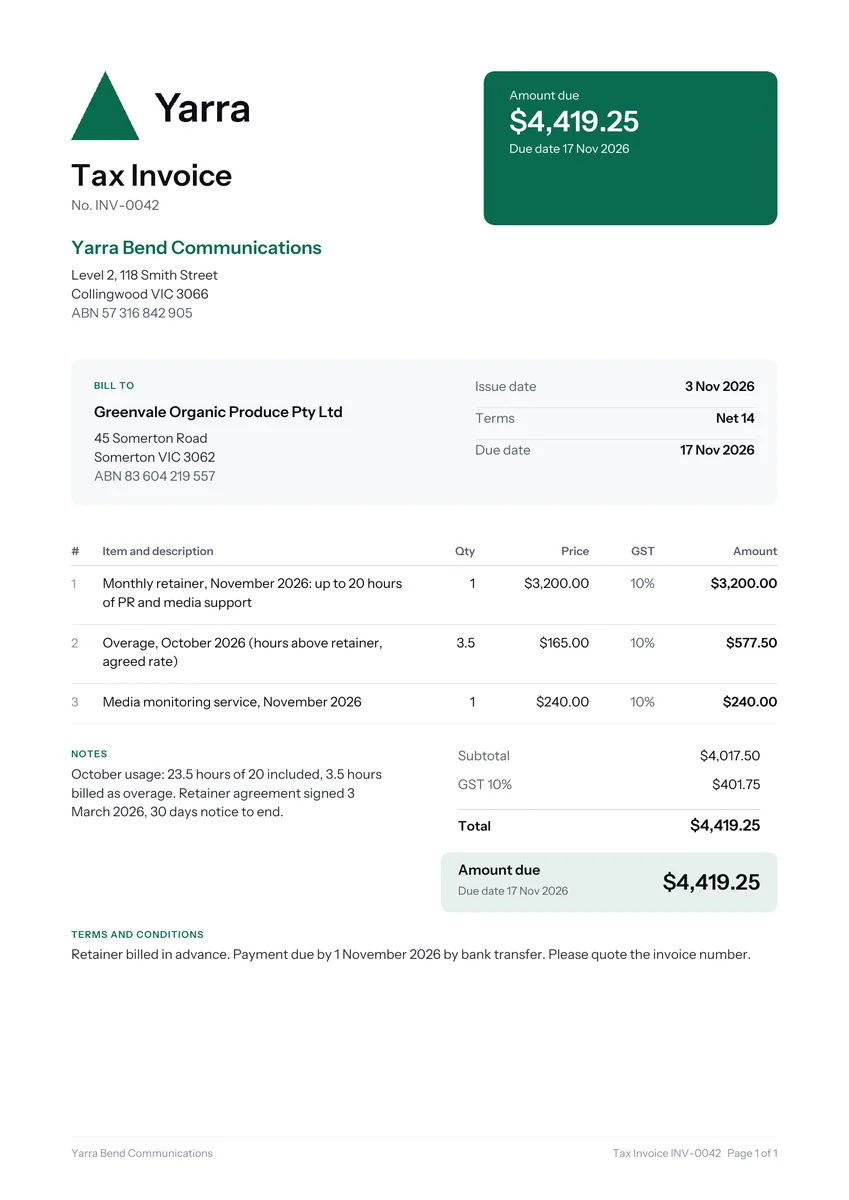
A made up Melbourne PR consultancy bills a client for November in advance. The retainer covers up to 20 hours a month. In October the team used 23.5 hours, so 3.5 hours of overage are billed at the agreed $165 rate. The consultancy is registered for GST, so it adds 10%.
| Line | Amount (A$) |
|---|---|
| Monthly retainer, November 2026, up to 20 hours | 3,200.00 |
| Overage, October 2026, 3.5 hours at $165 | 577.50 |
| Media monitoring service, November 2026 | 240.00 |
| Subtotal | 4,017.50 |
| GST at 10% | 401.75 |
| Total | 4,419.25 |
Under business.gov.au guidance, once a taxable sale passes $82.50 including GST, a registered business has to provide a tax invoice. It needs those two words, the seller’s business name and ABN, the date it was issued, what was sold with quantity and price, and the GST amount. As this bill is over $1,000, the client’s identity or ABN must appear on it too.
Retainer, recurring or hourly invoice?
They overlap, but the difference is what the client is paying for. A retainer buys access to your time, whether or not it is fully used. A recurring invoice bills a defined service delivered each cycle. An hourly invoice bills only the hours actually worked, after the fact, with no commitment either way.
- Same service every month, no hours involved? Use the recurring invoice template.
- Paid only for logged time? The hourly invoice template lists each session.
- Ending the arrangement? Send a final invoice that settles overage and any unused prepaid balance.
Retainer invoicing mistakes
Retainers break down when the client stops seeing what the fee buys, or when extra charges arrive without warning. Nearly every dispute comes from one of the habits below. Each one is fixed by writing a line or two more on the invoice, not by changing the agreement.
- No usage summary. After a quiet month, a bare fee looks like money for nothing.
- Overage without an agreed rate. Set the rate in the agreement before you ever bill it.
- Silent rollover. Say on the bill how many unused hours carried over, or that they lapsed.
- Billing late for an advance fee. A November retainer sent on 20 November confuses everyone.
- Mixing two periods. Keep this period’s fee and last period’s overage clearly dated.
Filling in this template
Start with the retainer sample in the invoice generator, which loads the PR example, then change the period, the included hours and the overage line. Put the usage summary in the notes. The same layout is on this page as a Word, Excel or PDF download if you would rather edit a file.
Pick the Australia preset to add GST at 10% and your ABN, and see our Australian tax invoice template for the full rules. Our guide to payment terms helps you set a due date for advance fees, and every other layout is on the invoice templates page.
Fill it in on screen and download or email a real PDF. No sign up.