How tailors charge for stitching and alterations
Tailors usually charge a fixed stitching price per garment type, adjusted for lining, design details and how quickly the customer wants it. Alterations are priced per job, such as a hem or a waist. When the tailor supplies the fabric, it goes on its own line by length, so the customer can see making charges and material separately.
- Stitching per garment: a kurta, blouse, shirt or suit has its own base price.
- Extras: lining, piping, padding, hooks, hand embroidery or a specific neck design.
- Fabric: customer supplied, or sold by the tailor per meter.
- Urgent work: a surcharge for delivery in a day or two.
Tailoring invoice template line items and example prices
The table shows lines an Indian tailoring shop might bill. Prices are examples in rupees to show structure only. Writing the fabric owner and design detail into each description stops arguments at collection about what was ordered.
| Line item | Basis | Example price (INR) |
|---|---|---|
| Kurta stitching, customer fabric | Per garment | ₹650 (example) |
| Blouse stitching with lining and back hooks | Per garment | ₹900 (example) |
| Two piece suit, made to measure | Per garment | ₹6,500 (example) |
| Trouser hem and waist alteration | Per job | ₹250 (example) |
| Lehenga fitting alteration | Per job | ₹1,200 (example) |
| Cotton lining fabric supplied | Per meter | ₹180 (example) |
| Urgent delivery within 48 hours | Per order | ₹400 (example) |
GST on a tailor invoice in India
A tailor who only supplies services must register for GST once aggregate turnover passes ₹20 lakh, or ₹10 lakh in Manipur, Mizoram, Nagaland and Tripura. For goods the limit is ₹40 lakh, lower in some special category States. Below the threshold that applies, issue a plain bill with no GST. Once registered, CBIC’s invoice rules apply.
- Your GSTIN: 15 characters, made of the State code, your PAN, an entity code and a check character.
- Numbering: a consecutive serial number, unique for the financial year.
- Tax split: CGST and SGST for a customer in your own State, IGST for one in another State.
- Codes and timing: the HSN or services accounting code, and a services invoice within 30 days of supply, made in duplicate.
GST rates were reorganized from 22 September 2025, so confirm the current rate for tailoring on the CBIC GST portal instead of copying an old bill. Our India GST invoice template page lists every field.
From order slip to final tailor invoice
A typical tailoring job starts with an order slip that records measurements, fabric received, the trial date and the advance. The final bill should carry the same slip number, so the customer can match the two, and it should show the advance as already paid with only the balance due at collection.
- At order: note fabric length and color received, the design, the trial date and the advance.
- After the trial: add any extra changes the customer asked for, with the agreed price.
- At collection: hand over the final bill, take the balance and note the payment method.
Alterations invoices for boutiques and dressmakers
Boutiques and dressmakers who send out alteration work in bulk often prefer one invoice a month. List each job with the boutique’s job card or tag number, the garment and the work done, so their staff can tick each item against the pieces returned. Agree a fixed price list for common jobs at the start.
A long list of small jobs reads better in an itemized invoice layout, where every hem and zip has its own row. Our guide on getting invoices paid faster has tips for monthly accounts that run late.
Tailor invoice mistakes to avoid
Tailoring disputes usually start at the collection counter, when the customer remembers the order differently. A bill with the slip number, the fabric received and the agreed extras settles most of those talks early. These are the gaps that cause trouble most often.
- No line per garment, just a single total for the whole order.
- Advance not shown, so the customer thinks the balance is wrong.
- Charging for changes after the trial without agreeing the price first.
- No collection deadline, leaving finished garments on your rail for months.
Load the Jaipur tailor sample
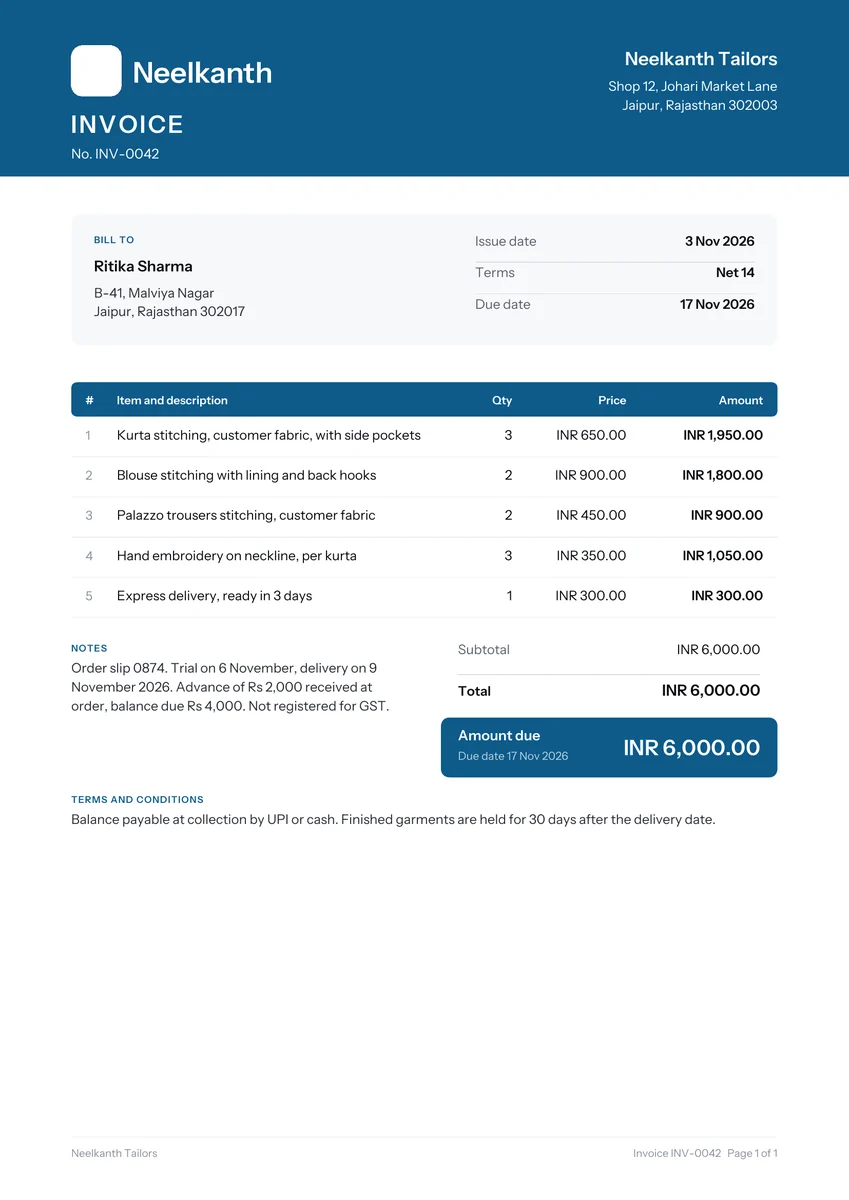
Open the tailor sample invoice and our free generator fills in three kurtas, two lined blouses, palazzo trousers, neckline embroidery and an express charge, with the advance noted and no GST because the shop is under the threshold. Choose India as the country if you register later, and the CGST and SGST fields appear.
Other designs sit in our invoice templates hub. Two more service trades with walk in customers: the barber invoice and the childcare invoice for weekly fees.
Fill it in on screen and download or email a real PDF. No sign up.