Full, abridged or none: the R5,000 and R50 lines
South Africa’s VAT Act sets three tiers by the consideration, including VAT. Above R5,000 you must issue a full tax invoice. Below R5,000 an abridged tax invoice is allowed, except for zero rated supplies. Below R50 no tax invoice is needed at all. SARS explains the tiers in chapter 13 of its VAT 404 Guide for Vendors.
| Consideration (incl. VAT) | Document | Buyer details and quantity? |
|---|---|---|
| More than R5,000 | Full tax invoice | Yes |
| Less than R5,000 | Abridged tax invoice allowed (not for zero rated supplies) | No |
| Less than R50 | No tax invoice required | Not applicable |
The guide’s own requirements table heads the full invoice column “R5 000 or more”, so a sale of exactly R5,000 is safest on a full invoice. Our template always has room for the buyer’s details, which makes the full version the default.
What a full tax invoice must show
A full South African tax invoice must show the words tax invoice, VAT invoice or invoice; your name, address and VAT registration number; the recipient’s name, address and, if they are a vendor, their VAT number; a serial number and date of issue; a full and proper description; the quantity or volume; and the value, VAT and total consideration.
| Detail | Full | Abridged |
|---|---|---|
| “Tax invoice”, “VAT invoice” or “invoice” | Yes | Yes |
| Supplier’s name, address and VAT number | Yes | Yes |
| Recipient’s name, address and VAT number (if a vendor) | Yes | No |
| Serial number and date of issue | Yes | Yes |
| Full and proper description, noting second hand goods | Yes | Yes |
| Quantity or volume supplied | Yes | No |
| Price and VAT by an approved method | Yes | Yes |
The wording rule is more relaxed than many people expect. SARS accepts any of the three titles, so a document headed simply Invoice is valid if everything else is present. Our South African preset uses Tax Invoice because the term leaves no doubt.
Three approved ways to show VAT
SARS approves three methods for showing the price and VAT. Method one lists the price excluding VAT, the VAT and the total including VAT. Method two shows the total with a statement “VAT included @ 15%”. Method three shows the total and the VAT amount, with a statement that VAT is included.
- Method one suits business customers, who see the net price and the VAT they can claim at a glance.
- Methods two and three suit counter sales and consumer jobs, where you quote VAT inclusive prices anyway.
In our editor, Tax Added produces method one, and Tax Included produces the inclusive total with the VAT stated, which is method three.
Worked example: a R95,550 solar installation at 15% VAT
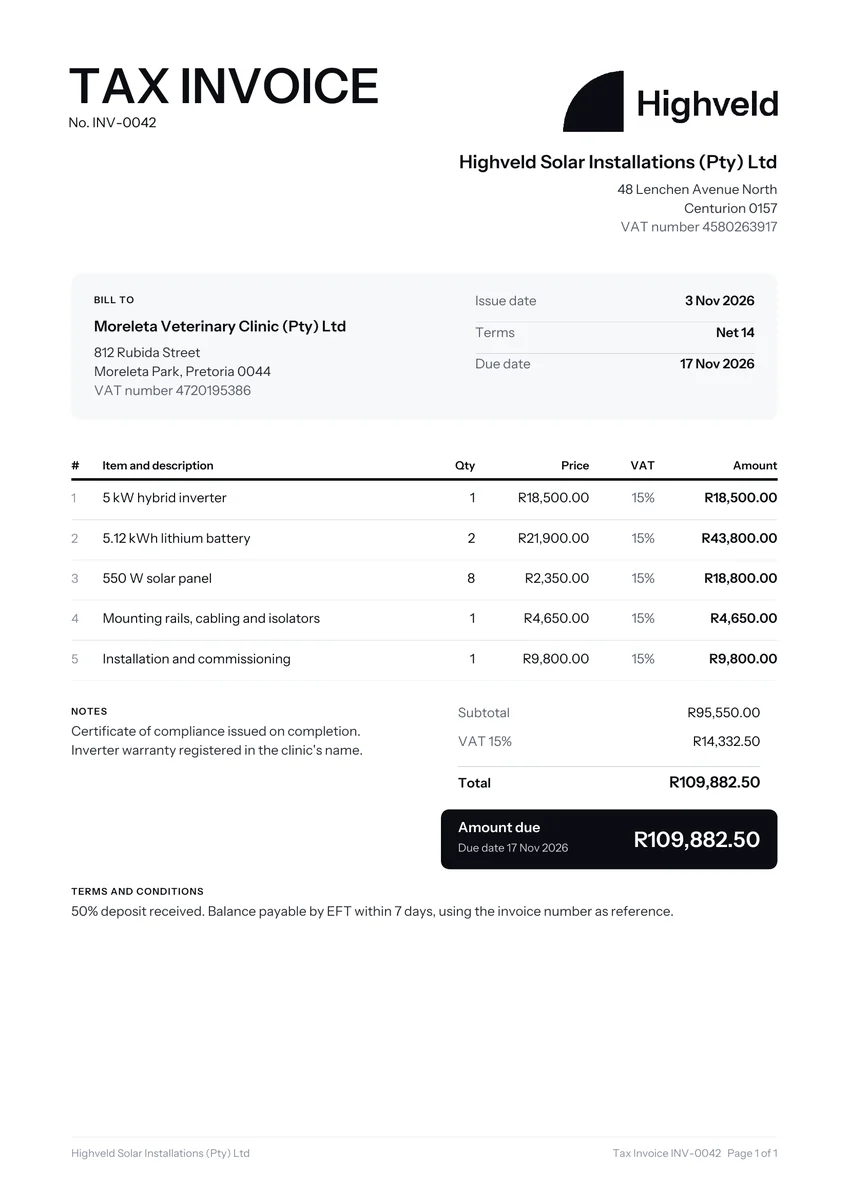
This made up full tax invoice is from a Pretoria solar installer to a veterinary clinic that is a VAT vendor. The lines total R95,550.00 excluding VAT. VAT at 15% is R14,332.50, so the clinic pays R109,882.50. Because that is far above R5,000, the clinic’s name, address and VAT number appear, and every line shows a quantity.
| Line item | Qty | Unit price | Amount |
|---|---|---|---|
| 5 kW hybrid inverter | 1 | R18,500.00 | R18,500.00 |
| 5.12 kWh lithium battery | 2 | R21,900.00 | R43,800.00 |
| 550 W solar panel | 8 | R2,350.00 | R18,800.00 |
| Mounting rails, cabling and isolators | 1 | R4,650.00 | R4,650.00 |
| Installation and commissioning | 1 | R9,800.00 | R9,800.00 |
| Total excluding VAT | R95,550.00 | ||
| VAT at 15% | R14,332.50 | ||
| Total including VAT | R109,882.50 |
Now a smaller job: a R2,300 call out to replace an isolator switch, VAT inclusive. The VAT is 15/115 of the total, which is R300.00. That fits an abridged invoice, showing your details, the serial number, date, description and “VAT included @ 15%”. SARS’s own examples write amounts as 28 000,00, with a space between thousands and a decimal comma.
Invoice template South Africa sellers use with no VAT
If you are not a registered vendor, send an ordinary invoice with no VAT line and no VAT number. SARS describes VAT as levied by registered vendors, and the tax invoice exists so that vendors can deduct input tax. From 1 April 2026, registration is compulsory once taxable supplies exceed R2.3 million in 12 months, up from R1 million.
The voluntary threshold also rose on 1 April 2026, from R50,000 to R120,000, so a smaller business can only register by choice once it passes that figure. In our generator, choose South Africa and set Tax to None: the title becomes Invoice and the totals show one amount.
The 21 day deadline, and why the rate is still 15%
A vendor must issue a tax invoice within 21 days of making a taxable supply, according to VAT 404. Failing to issue tax invoices is a contravention of the Act. The rate is 15%: a planned rise to 15.5% from May 2025 and 16% from April 2026 was reversed, and SARS confirms the standard rate remains 15%.
Two related rules affect how you price. All prices a vendor charges, advertises or quotes must include VAT, so your website and quotes show inclusive figures. And zero rated supplies sit at 0%, which our editor handles per line; just remember they always need a full tax invoice, never an abridged one.
Making it with the South African preset
On this page you can download the layout as a Word, Excel or PDF file. In the browser, the South Africa preset sets ZAR, VAT at 15% with 0% available on any line, the Tax Invoice title, A4 paper, and bank, branch code and account fields for EFT payments.
- Open the South African invoice generator and add your name, address and VAT number.
- Enter the recipient, with their VAT number if they are a vendor.
- Add quantities and prices, and choose Added or Included.
- Issue the PDF within 21 days of the supply.
For other VAT countries, the VAT invoice maker covers the UK, Ireland and the UAE. If you trade into the Gulf, see the UAE tax invoice template; for Australian clients, the Australian GST invoice. Every country is on the invoice templates page, and how to add VAT to an invoice covers the maths.
Fill it in on screen and download or email a real PDF. No sign up.